
Stratford's Annual Global Trends Report: 2026
Feel confident with your plans and strategies to grow and scale your organization in 2026. Drive results and accountability with a strategic plan that leverages trends and best practices.
https://www.stratford.group/full-service-ip-agency
What Leaders Need to Know to Navigate Constraint, Volatility, and Change
The global business environment entering 2026 is being reshaped by multiple, overlapping forces. Advances in artificial intelligence, rising cyber risk, geopolitical and regulatory volatility, energy and supply constraints, and growing expectations around trust and resilience are no longer emerging issues, they are structural realities.
Stratford’s 2026 Global Trends Report brings together insights from our work with leadership teams and analysis from reputable global sources to highlight where pressure is building, and what it means for strategy, execution, and decision-making in the year ahead.
The Eight Trends Shaping 2026
The eight trends that follow reflect structural shifts already underway, observable across industries and regions. Taken together, they point to a common challenge: organizations must become better at absorbing change, making trade-offs, and adjusting course continuously, all while still delivering reliable performance.
Mid-market organizations often feel these shifts first—and with fewer buffers. Limited slack, lean teams, and faster decision cycles mean changes in technology, regulation, energy, or supply can have an outsized impact on performance. This report is designed to help mid-market leaders focus on where pressure is building, which assumptions may be under strain, and where attention and investment will matter most in 2026.
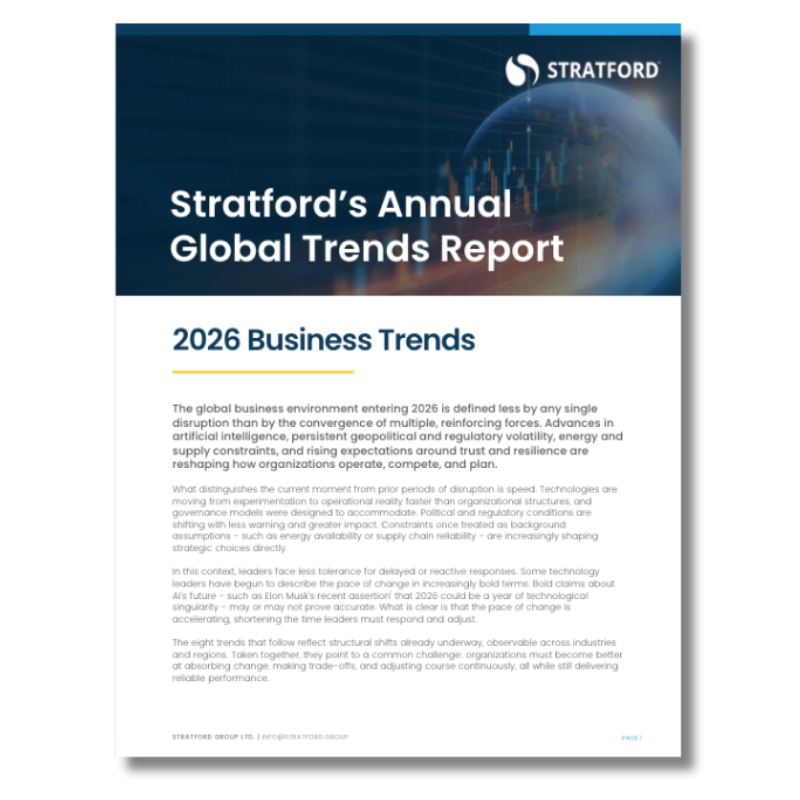
Interested in the Full Resource?
→ A deeper look at the eight global trends shaping 2026
→ Leadership insights on where pressure is building and why it matters
→ Practical questions to support discussion and decision-making
1. AI becomes part of how the business runs
AI is moving beyond experimentation and productivity tools into core business processes. The question for leaders is no longer whether to adopt AI, but how deeply it should be embedded into operating models, decision flows, and accountability structures.
2. Cyber resilience becomes a strategic imperative
Cyber risk increasingly threatens business continuity, trust, and enterprise value. As attacks grow more sophisticated and interconnected, organizations must treat cyber resilience as a leadership and governance issue rather than just a technical one.
3. Geopolitical and regulatory volatility becomes the baseline
Trade rules, regulation, and political conditions are shifting more frequently and less predictably. Organizations must plan for divergence, disruption, and rapid change rather than assuming stability.
4. Energy availability increasingly shapes competitiveness
Access to reliable and affordable energy is emerging as a constraint on growth and investment. Differences in energy availability and cost are influencing where organizations operate, scale, and deploy technology.
5. Supply chains are rebuilt for visibility and adaptability
Efficiency alone is no longer enough. Organizations are redesigning supply chains to detect disruption earlier and respond faster as delays and shortages become recurring realities.
6. Work is redesigned as tasks shift between people and AI
As AI and automation take on discrete tasks, jobs and workflows are being reshaped. Productivity gains depend less on tools and more on how roles, decision rights, and management practices evolve.
7. Trust in data becomes a strategic asset for growth
How organizations use data and automation increasingly affects customer loyalty, regulatory attention, and brand strength. Trust is becoming a key enabler—or constraint—on growth and adoption.
8. Strategy shifts from long-range planning to continuous reallocation
Volatility is forcing organizations to move away from static multi-year plans toward more dynamic approaches that emphasize learning, prioritization, and ongoing reallocation of resources.
Want the Full Resource?
Inside, you’ll get:
→ A deeper exploration of the eight global trends shaping how organizations operate and compete in 2026
→ Leadership-focused insights on how these trends translate into real constraints, trade-offs, and execution challenges
→ Practical questions and considerations to help leadership teams assess readiness and focus attention where it matters most